

Diet slip-ups around food happen to everyone, but there are skills you can learn so that you can reset fast after a diet slip-up. Ultimately, real life isn’t lived in a vacuum. It brings stress, travel, celebrations, late nights, and emotions that make it nearly impossible to stick to a plan with robotic precision. A moment of overindulgence or grabbing something convenient doesn’t mean you’ve failed. It’s just being a normal human.
But the real challenge isn’t the slip-up itself, it’s what often comes after. That downward spiral many of us know too well, where one choice snowballs into a series of choices that move us further and further away from our goals. Psychologists sometimes call it the “what-the-hell effect”.
I like to call it the shame spiral.
It usually starts with guilt: “I shouldn’t have eaten that.” That guilt quickly morphs into self-criticism: “What’s wrong with me?” Before long, it becomes all-or-nothing thinking: “I’ve ruined today anyway, so I may as well keep going and start fresh on Monday.” From there, it often leads to over-restriction, punishing workouts, or more overeating, all of which fuel the cycle rather than break it.
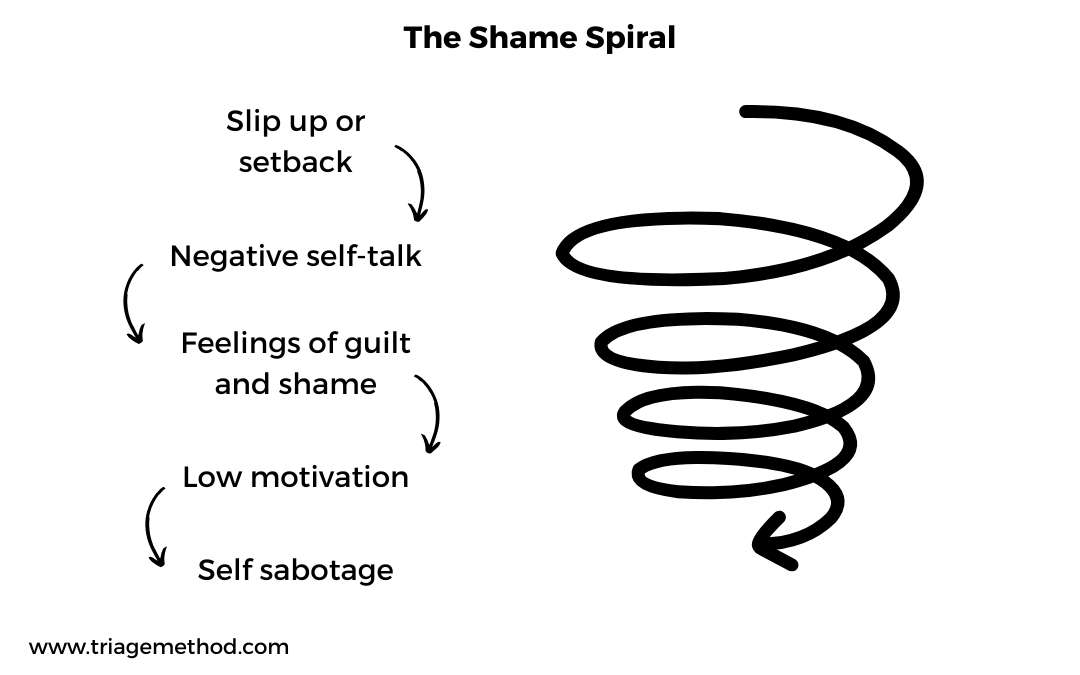
That spiral does far more damage than the original slip. Think of it like stepping in a puddle. Is it annoying? Sure. But now imagine you throw away your shoes because they got wet. You likely wouldn’t do that, because it doesn’t make sense.
However, one off-plan meal or one night of indulgence doesn’t undo your progress, but many, many people will spiral if they find themselves in this situation.
So, it’s the story you tell yourself about the event, and the actions that follow, that determine whether you bounce right back or dig yourself into a deeper hole.
This article is here to help you interrupt the default pattern. I’m going to show you how to reset quickly, regain perspective, and move forward without getting stuck in self-blame. We’ll talk about why slip-ups happen in the first place, how to reframe them as part of the process rather than proof of failure, and exactly what to do in the hours and days afterwards to get back on track. You’ll learn how to keep building consistency over time, even when life gets messy, so your identity becomes rooted not in rigidity but in resilience.
The thread running through all of this comes from an idea written nearly two thousand years ago by the Roman Emperor and Stoic philosopher Marcus Aurelius in his Meditations: “You have power over your mind, not outside events. Realise this, and you will find strength”. You can’t control the office party menu, the surprise birthday cake, or the flight delay that leaves you stranded at the airport. What you can control is the way you respond, the story you tell yourself, the next choice you make, and the habits you return to when things go sideways.
So as you read on, I want you to shake off the idea of perfection being required to progress. Instead, approach this with curiosity and an open mind. We need to treat every slip-up as feedback and information, and not a verdict on your moral worth. We need to notice what led up to it, decide how you want to respond, and then take one small step back toward alignment with your goals. That’s the game here. It’s not flawless execution, but steady recovery and forward momentum.
The reality is that we’ve all been there. You are not alone, and you almost certainly will have a diet slip-up in future. What matters isn’t the misstep itself, it’s what you choose to do next. By the end of this article, you’ll have a clear playbook for making that next choice a good one.
TL;DR
Diet slip-ups aren’t the problem, it’s the shame spiral that follows that is the problem. One off-plan meal doesn’t erase your progress, but beating yourself up about it can. The key is learning to reset fast: hydrate, move a bit, eat your next balanced meal, get some sleep, and reframe the story you tell yourself. Progress is built on resilience, consistency, and the ability to bounce back quickly when life inevitably gets messy. One choice never defines you. You can always make a good choice for your next one.
Table of Contents
- 1 TL;DR
- 2 Understanding Why Slip-Ups Happen
- 3 The Real Problem Isn’t the Slip-Up, It’s the Shame Spiral
- 4 Reframing Failure
- 5 The Immediate Reset: What to Do Right After a Slip-Up
- 6 Preventing the Spiral: The Mental Game
- 7 Emotional & Behavioural Techniques That Help
- 8 Science & Physiology Context
- 9 Practical Reset Toolkit
- 10 Long-Term Strategies to Reduce Slip-Ups
- 11 Social & Environmental Factors
- 12 When to Seek Extra Support
- 13 Reset Fast After a Diet Slip-Up: Conclusion
- 14 Author
Understanding Why Slip-Ups Happen
Before we talk about how to reset fast after a diet slip-up, we need to clear up a big misconception that slip-ups are a sign of weakness or poor discipline. They’re not. They’re part of being human. The truth is, even with the best intentions, life is going to throw you curveballs, and you are going to struggle to handle things.
Think about the realities we all face. Stress from work or family drains willpower. Social settings like birthday parties, holidays, and Friday nights out all come with foods and drinks that aren’t on your plan, but are part of living a full life. Sometimes it’s pure convenience because you’re tired, hungry, and grabbing the quick option feels easier than cooking. Add emotions into the mix (eating for comfort, reward, or distraction), and it’s no wonder even the most committed people find themselves off track now and then.
Too many of us approach nutrition with an “all-or-nothing” mentality, and that makes all of this stuff more difficult than it needs to be. For many of us, if the plan isn’t followed perfectly, it feels like failure. I am afraid to be the one to tell you, but perfection doesn’t exist in the real world, and especially not when it comes to nutrition.
You may have developed a fixed mindset around your abilities, especially as it relates to nutrition. But this can also be changed. A growth mindset sees mistakes as feedback, not proof you’re incapable. A fixed mindset says, “I blew it, so I’m done.” The growth mindset says, “I slipped, but I can learn and reset fast.” That shift is the difference between making one off-plan choice and letting it snowball into a lost week.
Biology also plays a huge role in diet slip-ups. Cravings aren’t just in your head, they’re tied to hormones like ghrelin and leptin, which regulate hunger and fullness. When you’re sleep-deprived, ghrelin (the “hunger hormone”) goes up while leptin (the “satiety hormone”) goes down, leaving you hungrier and less satisfied. Fatigue also feels like it lowers self-control. Dehydration can mimic hunger cues. Hormonal shifts, whether monthly cycles or stress-driven cortisol spikes, can all push you toward foods you wouldn’t normally crave.
Then there’s the psychology of eating. Many of us learned from an early age to associate food with comfort, celebration, or reward. Maybe dessert was the treat for finishing your homework, or maybe food was how your family expressed love. Those patterns don’t disappear just because you decide to get healthier. Emotional eating, boredom snacking, or reaching for something familiar when you’re stressed are habits built over lifetimes.
I always find it helpful to zoom out and look at this sort of stuff through an evolutionary lens. Our brains evolved in an environment of scarcity, where calorie-dense foods meant survival. Cravings for sugar, fat, and salt were protective when food was hard to find. In today’s world of abundance, where you have 24/7 access to fast food, snacks, and delivery, those same instincts feel like they’re working against us. This is just a mismatch between ancient wiring and modern circumstances, not a moral failing.
When you understand these drivers, you hopefully see why slip-ups are not just common, they’re almost inevitable. I don’t know about you, but I find knowing all of this to be quite liberating. You can stop treating slip-ups as proof that you’re broken, and start seeing them as part of the terrain of modern life. The key isn’t to prevent them forever (yes, you should still build skills to help avoid them, but they are bound to happen occasionally), but to build the skill of how to reset fast after a diet slip-up, so you can keep moving toward your goals with resilience instead of shame.
The Real Problem Isn’t the Slip-Up, It’s the Shame Spiral
In my experience coaching hundreds of individuals, the slip-up itself is rarely the thing that derails someone’s progress. What really causes the damage is the shame spiral that follows. I’ve seen this play out over and over again with clients, and I’ve experienced it myself.
The shame spiral usually begins with a moment of guilt. You eat something off-plan and immediately think, “I shouldn’t have had that”. Now, feeling guilty here in itself isn’t necessarily bad. It can nudge you to reflect and make a different choice next time. But too often guilt morphs into harsh self-criticism: “What’s wrong with me? Why do I always mess this up?”
From there, it slides quickly into the “I blew it” mentality: “Well, today’s ruined. I’ll start fresh on Monday”. Once that thought takes root, it often opens the door to more poor choices, more self-punishment, and eventually, throwing in the towel altogether.
This is why shame is so destructive. It doesn’t just make you feel bad in the moment, it actively fuels the very behaviours you’re trying to change. When you believe you’ve failed, you disconnect from your goals and from yourself. Instead of reaching for strategies that would help you reset fast after a diet slip-up, shame convinces you that it’s not even worth trying. The longer you sit in that mindset, the harder it becomes to climb out.
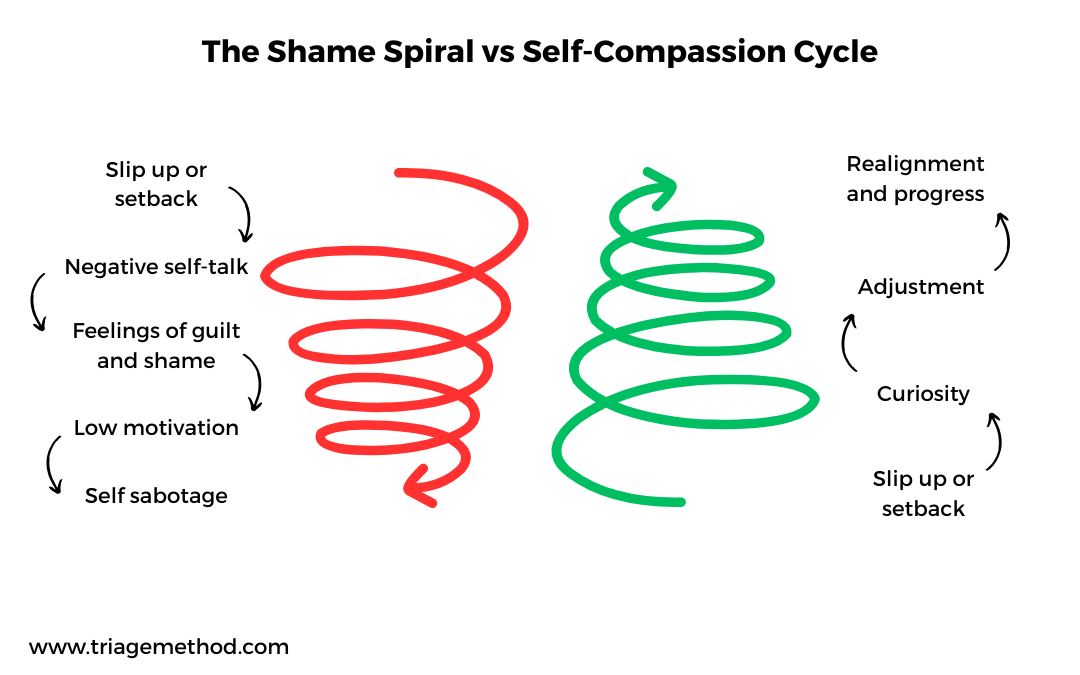
It’s important to understand the difference between guilt and shame. Guilt is about an action: “I overate at dinner.” Shame is about identity: “I’m a failure. I have no willpower.” Guilt can be productive if you let it guide you to reflect and take a different action next time. Shame, on the other hand, is corrosive. It erodes self-trust, undermines confidence, and keeps you stuck in the same cycle.
Research backs this up. Psychologist Kristin Neff, who has done pioneering work on self-compassion, found that people who respond to setbacks with shame are far more likely to repeat the behaviour. Those who respond with compassion by recognising their humanity and offering themselves the same kindness they’d offer a friend tend to recover faster, make better choices sooner, and build resilience over time.
Compassion isn’t letting yourself off the hook. It’s giving yourself the mental space to reset effectively instead of spiralling.
I think of one client who came to me after she had slipped up with the diet. It started as one dinner out with friends where she ordered more than she planned. The next morning, she stepped on the scale, saw it jump a couple of pounds (from nothing more than water and glycogen), and told herself, “See, I blew it again”. That one story she told herself about failure turned into a week of skipping workouts, eating mindlessly, and feeling worse by the day.
It wasn’t the pasta dinner that stalled her progress, it was the shame spiral that followed.
Once we started working together, she learned how to pause, reframe, and get back to her next balanced meal without judgment after these kinds of slip-ups. As a result, those spirals stopped lasting a week, and she was much better able to actually stick to her diet long term.
And that’s the skillset I want you to take away from this article. Ultimately, you are not defined by your last choice. You are defined by the pattern of your choices. Progress doesn’t come from perfection. It comes from stacking enough positive actions, day after day. As a result, that occasional slip just fades into the background. The slip-up isn’t a big problem, it is the shame spiral that is the problem. Breaking that spiral is one of the most powerful skills you can build.
Reframing Failure
Now, one of the most powerful ways you can reset after a diet slip-up, is by learning to stop seeing slip-ups as failures and start seeing them as feedback. When a client tells me, “I failed because I ate pizza last night,” my first thought is usually, “Nope, you just got data.”
That one choice to eat some pizza doesn’t define you, and ultimately, it teaches you a lot. Maybe it tells you that you skip meals when you’re busy, and then arrive home ravenous. Maybe it shows you that stress makes you crave comfort foods. Maybe it reveals that you need a plan for social settings. None of that is failure. It’s information you can use to adjust and move forward.
Athletes understand this better than most. Every rep in the gym, every set on the court, every game in the season teaches you something, even the losses. In fact, losses often teach the most. Nutrition is no different. A “bad day” with food isn’t a judgment on you, it’s just another practice rep. It’s one more chance to practice resetting, to build awareness, to strengthen your ability to get back on track quickly. It’s just more information so you can make your systems more robust and resilient in future.
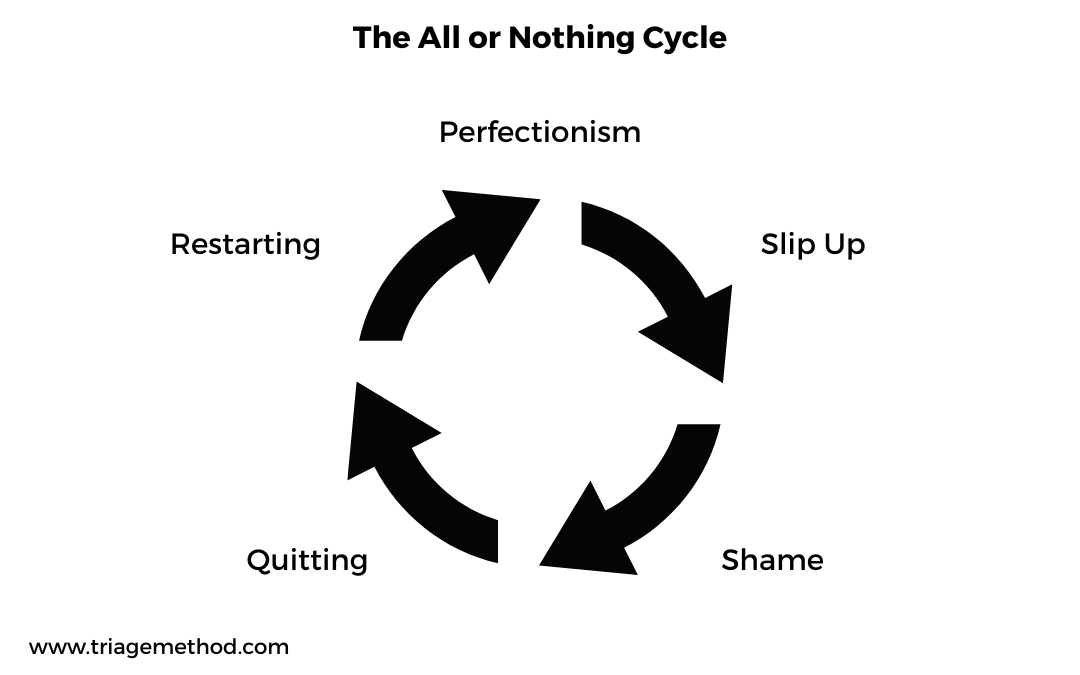
The key here is aiming for progress over perfection, which I know many people struggle with. Too many people chase flawless execution. They try to have perfect macros, perfect workouts, perfect sleep, perfect, perfect, perfect. But when life inevitably throws a wrench in the plan, they feel like it’s all over.
But all of this health and fitness stuff isn’t about perfection, it’s about consistency. Ten average days beat one perfect day followed by a week of “I gave up.” The people who succeed long-term are the ones who can wobble, reset fast after a diet slip-up, and keep stacking days of effort.
The Stoic philosopher Epictetus said, “It’s not what happens to you, but how you react to it that matters.” You can’t control the office donuts or the unexpected dinner out, but you can control what you do next. Yes, we can build systems that make it less likely that you will overindulge on these various slip-up opportunities, but the reality is that it is going to happen occasionally. Your energy shouldn’t go into reliving the slip-up, but into making your next choice a good one that gets you right back on track.
One slip-up doesn’t need to turn into a week off track. Ultimately, every time you reset, you’re not just salvaging your nutrition for the day, you’re rewiring your brain. Through neuroplasticity, repeated resets strengthen the mental pathway that says, “I bounce back fast.” Each time you practice that skill, it becomes easier, until eventually resilience is just your default. You stop seeing food choices as a battlefield and start seeing them as part of a longer journey where every choice counts, but no single choice defines you.
That’s what reframing failure really means. It’s not pretending mistakes don’t happen. It’s recognising that each slip-up is an opportunity to learn and build a stronger system for the future.
The Immediate Reset: What to Do Right After a Slip-Up
So you had the extra dessert, the second plate at dinner, the handful of snacks that turned into half the bag, or whatever situation you find yourself slipping off track with the diet. What do you do now?
This is the moment where most people fall into the shame spiral, but it’s also the exact moment where you can turn things around. If you want to reset fast after a diet slip-up, it’s not about punishment or overcorrection. It’s about calm, simple actions that bring your body and mind back into balance.
The first step is to pause. Take a breath and release judgment. In Acceptance and Commitment Therapy (ACT), there’s a principle called “defusion,” which effectively boils down to noticing your thoughts without becoming tangled up in them. Instead of fusing with, “I’ve blown everything,” you learn to say, “I notice I’m having the thought that I’ve blown everything.” That doesn’t seem like a huge difference, but that tiny bit of distance keeps the thought from dictating your next choice.
You accept that the slip-up happened. You remind yourself that one choice doesn’t define you. You move on. Reflection and deeper learning will come later, but right now, the mission is simply to dust yourself off and take the next step forward.
I often teach clients a four-part framework for moments like this:
- Slip → You slip up.
- Scan → Assess the situation. Notice what happened without drama and try to identify the trigger or context that led there. (Were you tired? Stressed? Bored? Celebrating?)
- Simplify → Choose one small, stabilising action that will get you back feeling like you are building momentum towards your goals.
- Start → Do it now. No waiting until tomorrow, no bargaining with yourself to “just start Monday”. Just one action to shift the momentum.
The reset doesn’t need to be dramatic, and very often it is really just a nudge that you need to get back on track. Think of it like steering a car back onto the road after drifting toward the shoulder, you don’t jerk the wheel, you guide it gently.
The faster you can shift from judgment to action, the faster you can reset after a diet slip-up. It’s not about erasing what happened. It’s about putting the next building block in place, so you can keep moving towards your goals. When you repeat this skill enough times, you’ll find that slip-ups stop derailing you. They just become small bumps on a much longer road.
However, eventually comes the part that feels hardest for most people: eating again. The most common reaction after overeating is to just continue binge eating, but there is a significant cohort of people who choose to skip the next meal or severely restrict food to “make up for it”. But your metabolism doesn’t work like a bank account. Fat gain doesn’t come from one day of eating. Fat gain comes from a consistent energy surplus over time. What helps most is getting back to your normal rhythm with a balanced meal of protein, fibre, and healthy fats. That stabilises your blood sugar, tames cravings, and signals to your brain and body that you’re back in routine.
You may be less hungry, especially if the meal you had when you had the diet slip was quite calorie-dense. So, you don’t need to force-feed yourself here, but you do want to get back into a normal rhythm of things as soon as possible.
Your next meal isn’t about undoing the slip, it’s about re-establishing trust with yourself. When you provide your body with steady, balanced nutrition, you’re essentially saying, “We’re okay. We’re back on track.” That reassurance is far more powerful for long-term progress than skipping meals, punishing yourself with exercise, or waiting until Monday to “start fresh.”
If appetite is low, keep it light but structured. A simple plate of lean protein, some vegetables, and a healthy fat source is often enough. If you are genuinely hungry, let that next meal be satisfying and balanced, not another cycle of restriction and rebound. Both options serve the same purpose: creating stability.
This step is also where many people discover that the slip-up wasn’t as catastrophic as it felt in the moment. Once you’ve eaten a balanced meal and hydrated, the fog of shame and guilt lifts. You’re reminded that one choice, or even one whole day, doesn’t undo weeks or months of progress.
What truly matters is momentum and being in a rhythm, not perfection. The more you practice returning to your baseline routine after a slip, the less emotionally charged those moments become. Food stops holding power over you, and the idea of a “ruined day” disappears. Instead, you build resilience and a trust in yourself that no matter what happens, you can always return to centre.
The real goal is not flawless eating, but flexible consistency. The ability to reset quickly and calmly is what carries you forward, meal by meal, week by week, toward the outcome you’re working for.
Preventing the Spiral: The Mental Game
The real secret to long-term success is learning how to stop the shame spiral before it starts. Nutrition and fitness aren’t just physical, they’re deeply mental. The way you talk to yourself in those crucial moments makes all the difference in whether a small bump in the road becomes a full derailment.
One of the first strategies I teach clients is the power of language reframes. Words shape perception, and perception shapes behaviour. Instead of saying, “I failed,” try, “I learned.” One tells you the story is over, while the other tells you it’s still unfolding. Instead of saying, “I’m off track,” try, “I’m still on the journey.” This shift in the way you view things turns a slip-up from a dead end into a minor detour. It reminds you that the road is still there and all you need to do is steer back onto it.
This reframing ties directly to the concept of a growth mindset. In Carol Dweck’s research, people who see challenges and mistakes as skill-building opportunities are far more resilient than those who view them as fixed verdicts. I encourage clients to think of every slip-up as a “skill rep”. Just like you wouldn’t expect to get stronger in the gym without doing reps, you can’t expect to build resilience without practice. Every recovery, every reset, is another rep training your mental muscle.
This is where identity becomes powerful. If you build your self-image around resilience instead of rigidity, you stop expecting perfection from yourself and start trusting in your ability to recover. I sometimes ask clients to do what I call an “identity audit.” In the moment after a slip-up, pause and ask: “What would someone who is consistent do in the next ten minutes?” Then do that thing. That might be drinking a glass of water, going for a short walk, or prepping your next meal. Each time you choose the resilient response, you reinforce the identity of someone who gets back up quickly.
Ultimately, the harsher you are after a slip, the more likely you are to repeat it. Self-criticism doesn’t build discipline, it builds fragility. Self-compassion, on the other hand, builds strength. It teaches your brain that you can stumble without quitting, and that lesson is what allows you to sustain progress over months and years.
Now, the goal isn’t to create an identity of perfection. It’s to create an identity of persistence. When you see yourself as resilient, every slip becomes just another chance to practice getting back up, and that’s the skill that carries you forward for life.
Of course, we can’t always rely on willpower alone. That’s why I also teach what I call “floor-not-ceiling” habits. Too often, people set the bar so high that the moment life gets chaotic, everything crumbles. Floor habits are your minimum standards, even on the hardest days. These are the small anchors that keep you tethered to progress no matter what. They are ideal things you can do, even on your worst days. Stuff like staying hydrated, getting some protein with your meals, moving your body, and protect a reasonable sleep window, or whatever else makes sense for your exact situation. When you understand the difference between floor habits and ceiling habits, it is much easier to see what you need to do to keep things on track. Rather than binary on and off track, you see things as a continuum.
Another way to prevent spirals is through reflection. A simple journaling practice can help you identify the triggers that lead to slip-ups. Was it stress, fatigue, boredom, or social pressure? When you spot patterns, you can prepare for them instead of being blindsided. This isn’t about beating yourself up; it’s about gathering data. In fact, I tell clients to think like scientists running an experiment: observe, record, adjust. You aren’t going to develop a system that works everytime, and you will have to tweak and iterate on your plan until it is really dialled in for you.
Neuroscience gives us another helpful lens here. Habits run on loops: cue → routine → reward. If your cue is stress and your routine is reaching for chocolate, the reward is temporary comfort. Breaking that cycle doesn’t happen by shaming yourself. It happens by swapping in a different routine that still delivers a reward. Stress cue? Instead of food, maybe it’s a five-minute walk or a quick call with a friend. This sounds silly, but the diet slip up isn’t a problem, it is a solution to your problem. You can’t just get rid of that solution without replacing it with something better. Over time, these new routines rewire your default responses, and it becomes much easier to stay on track and to reset fast after a diet slip up.
As many of you know, I really quite enjoy reading philosophy, and wouldn’t you know, philosophy also has wisdom to offer here. Aristotle’s golden mean reminds us that virtue lies in balance, not extremes. Perfectionism pulls us to the extreme of restriction, rigidity, and self-punishment. Indulgence pulls us to the other extreme of throwing caution to the wind and going all-out.
The virtuous middle is balance: flexibility without self-abandonment, structure without obsession. That’s the path we want to be on.
But you do have to realise that there is the tug-of-war happening in your brain. The prefrontal cortex (the rational part that makes long-term decisions) is constantly wrestling with the limbic system (the emotional, impulse-driven part). When you’re stressed, tired, or depleted, the limbic system usually wins. That’s why the feeling of decision fatigue hits at the end of the day, and often leads to impulsive choices.
The solution isn’t superhuman discipline, it’s pre-committing simple defaults for your “tired brain” moments. Things like: “When I get home, I’ll pour a glass of water before I grab food,” or “I’ll keep cut-up veggies or a protein shake ready for evenings.” I personally like “if-then” plans for this kind of stuff, but realistically, you just need to have some sort of plan in place ahead of time. Defaults reduce friction when your decision-making power is low.
Finally, I encourage a form of Socratic reflection. Instead of panicking after a slip-up and asking questions like “What’s wrong with me? Why do I always mess this up?”, instead, ask calm, curious questions: “What led to this?” “Was I stressed, hungry, lonely, or just tired?” This kind of self-inquiry builds wisdom. Knowing yourself is the first step to mastering yourself. Once you understand the “why” behind your choices, you can change the “how” moving forward.
Preventing the spiral isn’t about never slipping again. It’s about equipping your mind with the tools to respond differently when you do. With reframes, floor habits, reflection, and a deeper understanding of your own psychology, you build resilience.
Emotional & Behavioural Techniques That Help
When it comes to building resilience after slip-ups, the real battleground isn’t your plate, it’s your mind. The thoughts, emotions, and stories you attach to eating decisions often matter more than the food itself. That’s why developing emotional and behavioural techniques is so powerful. These are the tools that keep a single misstep from turning into a spiral, and they’re what allow you to reset fast after a diet slip-up instead of staying stuck.
One of the most effective techniques is mindfulness. That doesn’t mean sitting cross-legged on the floor for an hour. It can be as simple as pausing before you react and noticing your thoughts without judgment. Instead of automatically reaching for food when you feel stress, you pause long enough to ask, “What’s happening right now? Am I actually hungry, or am I tired, bored, or anxious?” This moment of awareness creates a gap between impulse and action, and in that gap, you have the opportunity to get your power back.
A related practice is something psychologists call “urge surfing.” This can be especially helpful if the reason you have diet slip ups is due to cravings. You can think of a craving like a wave. It rises, peaks, and eventually falls away. Instead of fighting the craving or immediately giving in, you ride it. You acknowledge it, breathe through it, and let it pass. Most cravings last only a few minutes if you don’t feed them. By practising urge surfing, you train yourself to respond with patience rather than panic.
On a more practical level, I encourage clients to build micro-habits that reinforce resilience. These are small, daily actions that reduce friction and keep you grounded: a two-minute reflection at the end of the day, keeping prepped snacks handy, or using short affirmations like, “One choice doesn’t define me.” Each micro-habit seems small, but together they create a safety net that keeps you from falling into the shame spiral when life gets messy. And it will get messy.
Cognitive-behavioural therapy (CBT) also gives us powerful tools. One of the simplest is reframing, which we touched on before. If you catch yourself thinking, “I blew it,” that thought almost guarantees escalation: more eating, more guilt, more distance from your goals. But if you reframe it to, “I slipped, but I can reset with my next choice,” the cycle ends right there. Same event, completely different outcome.
Philosophy can deepen these practices. I am a big fan of using Nietzsche’s idea of the eternal return as a thought experiment, and I often share it with clients. Imagine that today, exactly as it unfolded, had to be repeated for eternity. Would you want this moment, this choice, this slip-up to be part of the loop? If not, what could you do right now to change the story? The point isn’t to be dramatic, it’s to anchor you in the significance of small choices. Even a five-minute reset action can alter the trajectory of the “loop”, and thus your life.
Buddhist philosophy adds another layer with the idea of non-attachment. Picture your slip-up as a leaf floating down a stream. You don’t need to grab it, clutch it, or make it part of your identity. You simply notice it, let it pass, and continue walking alongside the water. When you stop gripping the slip-up as proof of failure, you free yourself to act differently in the very next moment. This is a technique that is very often used in Acceptance and Commitment Therapy (ACT) when discussing defusion.
Of course, there are many other emotional and behavioural tools and techniques, but hopefully these have given you some practical ways to interrupt spirals and cultivate resilience.
Science & Physiology Context
Beyond just discussing the mind, I do find it very helpful to understand a little bit more about what is happening in the body when you do have a diet slip-up, as it really does help us to make better choices long term. A lot of the panic people feel the morning after overeating comes from misunderstanding the physiology, and this leads to a succession of bad choices. Most people step on the scales the morning after a diet slip up, see it jump a couple of pounds, and assume they’ve instantly gained fat. This then leads to the shame spiral and further eating off track. But the science tells a very different story, and once you understand it, you’ll see why you can reset fast after a diet slip-up without fear.
In the short term, overeating does create noticeable effects. Your blood sugar will spike higher than usual, which can leave you feeling sluggish, sleepy, or craving more sugar once it drops again. Digestion may feel heavier or slower, especially if the meal was large, fatty, or salty. And you’ll often hold onto extra water because of sodium intake, which makes you feel bloated or puffy. None of this is pleasant, but none of it means you’ve undone weeks of progress either.
This is why if you do have a diet slip-up, I am a big fan of doing something to move your body. This is not to “burn it off,” but to help your system process what you’ve eaten. A brisk walk after a meal can dramatically improve blood sugar disposal, thanks to the way your muscles act like sponges for glucose. Even ten or fifteen minutes makes a difference. This isn’t about punishment, it’s about actually helping your body to process the food you have eaten.
In most cases, you will see the weight on the scales go up after a diet slip up. But this is almost always temporary. When you eat more carbohydrates than usual, your body stores them as glycogen in your muscles and liver. For every gram of glycogen stored, your body holds on to roughly three grams of water. Add a salty meal on top of that, and sodium causes your kidneys to retain even more water. The scale might go up two, three, even five pounds after a big indulgence, but that’s glycogen and water, not body fat. Within a day or two of normal eating, hydration, and movement, those numbers drop right back down.
Real fat gain happens over time when your energy intake consistently exceeds your energy expenditure. One day of overeating doesn’t move that needle in any significant way. In fact, the human body is remarkably adaptable. Just as it can handle an occasional missed meal without breaking down, it can handle an occasional oversized meal without storing everything as fat. Metabolism is about patterns, not snapshots. You are what you repeatedly do, not what you do occasionally.
Ultimately, biology rewards consistency, not perfection. Your body doesn’t demand flawless execution and it thrives when you give it steady, balanced inputs over time. That’s why the single most effective thing you can do after a slip-up isn’t to punish yourself, it’s to reset quickly and return to the habits that move you forward. One indulgent night won’t erase weeks of progress, but letting shame spiral into weeks of inconsistency can.
Practical Reset Toolkit
At this point, you understand why slip-ups happen, why the shame spiral is more damaging than the slip itself, and how to approach recovery with a resilient mindset. Now it’s time to put it all together into a simple toolkit you can use anytime you need to reset fast after a diet slip-up. Think of this as your “post-slip-up ritual,” a reliable sequence of actions (rather than thoughts) that makes recovery predictable, non-dramatic, and almost automatic.
The first step is hydration. A big glass of water is often the fastest way to start feeling better. It helps clear excess sodium, reduces bloating, and kick-starts digestion. Most people are surprised by how quickly this alone can change how they feel.
Next, move your body. This doesn’t mean punishing yourself with a hard workout, it means using gentle movement to support your physiology. A brisk walk, a light bike ride, even stretching on the floor will help shuttle glucose into your muscles, stabilise blood sugar, and restore level energy. You’re not trying to erase the slip-up, you’re just trying to help your body process it efficiently.
After that, return to a balanced meal. Don’t skip or over-restrict in an effort to “make up for it.” That usually backfires, leading to more cravings and less stability. Instead, aim for a meal of protein, fibre, and healthy fats. A normal, steady meal signals to your brain that “we’re back on track”.
Once the basics of hydration, movement, and food are covered, take a moment for reflection. A quick journal entry (even two or three sentences) can help you notice what triggered the slip. Were you stressed? Overtired? Socially pressured? The point isn’t judgment here. The point is to build awareness. Over time, these notes reveal patterns that make future resets even easier.
Finally, I highly recommend that you prioritise sleep. It’s one of the most underrated tools for recovery. A solid night of rest resets your hunger hormones, sharpens decision-making, and gives you the fresh start your body and mind need. Sometimes the best “reset action” isn’t in the kitchen or the gym, or some mindset trick, it’s simply going to bed.
To tie it all together, I encourage clients to think in terms of Next-Choice Wins. Your scoreboard doesn’t record yesterday or even this morning. It only records your very next play. Slip-ups stop being dramatic once you understand this. The only choice that matters is the one directly in front of you.
You don’t live in the past. You don’t live in the future. You live in the present moment. You can only make choices in the present moment, so that is what you should be focused on.
And if you need a little mental nudge, try the eternal return question. Ask yourself: If this evening repeated every day for a year, what one five-minute action would change the story? Maybe it’s a glass of water, a short walk, or prepping tomorrow’s breakfast. That single action can shifts your trajectory over time.
With this toolkit, you’re well prepared to reset fast after a diet slip-up. But we do also have to consider the longer term, and reducing slip-ups in the first place.
Long-Term Strategies to Reduce Slip-Ups
So far, we’ve focused on how to reset fast after a diet slip-up when it happens. But what about reducing the likelihood of those slip-ups in the first place? The goal isn’t to eliminate them entirely, as that’s impossible, but we can create a lifestyle and environment that makes consistency easier and spirals less frequent. Think of this as building a strong foundation. The steadier the base, the less likely you are to wobble when life gets messy.
The first piece of that foundation is nutrition planning. This doesn’t mean rigid meal plans or cutting out every food you enjoy. In fact, the opposite approach usually works better. We want to build balance, flexibility, and sustainability into our nutrition plan. Allow yourself treats in moderation rather than creating “forbidden foods” that feel like ticking time bombs. When nothing is off-limits, food loses its power to control you. You can enjoy a slice of cake at a birthday party without guilt because you’ve already accounted for flexibility in your approach.
If you don’t know how to set up a well-balanced, calorie appropriate diet, then I highly recommend that you read through the articles in our nutrition hub, and in particular, the review article on how to set up your diet.
Beyond setting up your diet correctly, and equally important are what I call lifestyle anchors. These are the daily habits that keep your physiology stable, like getting enough sleep, managing stress, and staying hydrated. Lack of sleep alone can disrupt hunger hormones, making cravings far harder to resist. Stress increases cortisol, which pushes many people toward comfort eating. And even mild dehydration can mimic hunger signals. By protecting these anchors, you prevent many slip-ups before they start.
Your environment matters just as much. Willpower feels like a limited resource, but the environment is 24/7. If your fridge is stocked with prepped, balanced meals and your cupboards are filled with supportive options, you’ve lowered the friction for making good choices. If you surround yourself with people who support your goals, whether that’s family, friends, or an online community, you’ve built in accountability. A coach, a workout buddy, or even a group chat that celebrates small wins can be the difference between giving up and getting back on track.
There’s also the importance of systems thinking. One of the most common traps I see clients fall into is the sunk-cost fallacy: “I already messed up, so I might as well keep going.” But small pivots compound into success. Maybe lunch didn’t go as planned. So what? Dinner is still an opportunity to eat a balanced meal. Each reset interrupts the spiral and keeps your average trending in the right direction. When you zoom out, progress is always built on averages, not single events.
Finally, we can’t ignore the role of modern medicine in this realm, as it is a huge support for many people. Medications like GLP-1 receptor agonists have become part of the conversation around weight management, whether you personally want to acknowledge them or not. These drugs can reduce hunger cues and help people control portions, which can be a real game-changer for some. However, medication can support physiology, but it doesn’t build resilience or identity. If the only tool you have is external, you’re always dependent on it. Skill-building and learning how to reflect, reframe, and reset are what shape your identity as someone who can adapt and persist. Ideally, medication and behaviour work hand-in-hand here. It shouldn’t be seen as an either-or discussion.
In the end, long-term success comes from layering these strategies together. When combined, they make slip-ups less frequent and far less dramatic. When slip-ups do happen, you already have the resilience skills to bounce back quickly, keeping your journey consistent, sustainable, and deeply human.
Social & Environmental Factors
Now, I realise that you may still have a few questions about how to prevent slip-ups in the first place, as I know we didn’t cover everything. But the final thing I do want to discuss, that should help you round out your skillset, is how to address some of the social and environmental factors that can often lead to diet slip-ups.
For many people, the hardest slip-ups don’t happen when they’re home alone with a meal plan and a stocked fridge. They happen out in the real world, at family dinners, birthday parties, work trips, holidays, or simply when life doesn’t go according to plan. Social situations and changing environments are part of life, and if your nutrition approach doesn’t account for them, you’ll constantly feel like you’re falling off track. The good news is that with the right mindset and strategies, you can reset fast after a diet slip-up and even prevent many of them before they happen.
Food is about more than fuel. From an evolutionary perspective, humans eat to bond. Sharing meals is a survival instinct that goes back thousands of years. Connection over food (and exercise!) was how communities built trust, shared resources, and passed down culture. That’s why birthdays come with cake, holidays come with feasts, and nights out often revolve around restaurants. Eating together is part of being human, and it is not a moral failure. The real skill is learning how to participate with flexibility instead of all-or-nothing thinking.
One practical way to do this is to plan flexible indulgences. Instead of thinking, “I can’t have anything off-plan or I’ve failed,” go in with the mindset of choosing making good choices where possible and if you do want to indulge a bit more, try to choose what actually feels worth the trade offs. Maybe it’s your grandmother’s apple pie (this is what gets me every time) that you only get once a year, or the local dish you want to try while travelling. When indulgences are intentional, they feel like part of the plan instead of a break from it. You enjoy them fully, then move right back to your normal habits without guilt.
Communication is another key piece. Many clients feel pressured because they don’t know how to say “no” to food without offending someone. The truth is, you can decline with kindness and without shame. Simple phrases like, “That looks amazing, but I’m satisfied right now,” or, “I’ll pass for now, thank you,” go a long way. On the flip side, sometimes saying “yes” is the right choice if it supports connection with the people you care about. Again, this isn’t about perfection, it’s about balance.
When it comes to travel, holidays, or dining out, a little foresight can make all the difference. I often recommend focusing on “big rocks” instead of trying to control every detail. That means staying hydrated, eating a relatively calorie-appropriate diet, listening to your hunger signals, getting some protein at each meal, moving your body when you can, and protecting your sleep as much as the schedule allows. Those anchors keep you steady, even if the food options aren’t ideal. And if you do end up eating more than planned, you already know what to do: reset fast, get back to your next balanced meal, and keep going.
The takeaway here is that social and environmental challenges don’t have to derail your progress. When you embrace food as both nourishment and connection, plan indulgences with intention, and communicate confidently, you make these situations predictable and manageable. Instead of being landmines that trigger shame spirals, they become opportunities to practice flexibility and build resilience.
When to Seek Extra Support
Everything we’ve talked about so far is designed to help you reset fast after a diet slip-up and prevent the shame spiral from taking over. But sometimes, the patterns run deeper. If you notice the same cycles repeating again and again, despite your best efforts, it may be a sign that extra support is needed.
Some red flags to watch for include consistent binge-restrict cycles, where periods of overeating are followed by extreme restriction or punishing exercise. Another is relying heavily on workouts as a form of “penance” for food, rather than movement being a source of health and strength. Or you may notice that food choices are often tied to deeper emotional triggers (stress, loneliness, anxiety, or past experiences) that go beyond normal hunger and fullness cues.
When these patterns show up, it doesn’t mean you’re broken. It means you’re human, and you don’t have to navigate it alone. Just like an athlete turns to a coach, or a student turns to a teacher, sometimes the most powerful step you can take is asking for help.
Professional support can come in many forms. A therapist can help you unpack the emotional layers driving food choices. A nutrition coach can provide individualised nutrition guidance that removes confusion and builds clarity, and they can walk alongside you with accountability, encouragement, and structure, helping you turn insights into action. Each of these brings a different kind of expertise, and together they can help you break destructive cycles and build a healthier relationship with food, movement, and yourself.
There’s strength in knowing when to reach out. Sometimes the bravest move isn’t pushing harder on your own, it’s letting someone else walk with you until you’ve built the resilience and confidence to carry it forward yourself.
Reset Fast After a Diet Slip-Up: Conclusion
At the end of the day, a diet slip-up is just that. It’s a single moment, and not your identity. It doesn’t cancel out weeks of effort, and it certainly doesn’t define who you are. One choice never erases your progress. What matters is what you choose to do next.
The key is to remember that your power lies in the present moment. You don’t need to fix yesterday, and you don’t need to control tomorrow. All you need to do is focus on your very next choice. Ultimately, health is built on resilience, not perfection. The people who succeed long-term aren’t the ones who never slip, they’re the ones who bounce back quickly, again and again, until recovery becomes second nature.
This principle doesn’t just apply to diet. It applies to every area of life. Whether it’s fitness, work, relationships, or personal growth, setbacks are inevitable. What defines you is not the stumble, but the recovery. Not flawless execution, but the ability to reset and keep moving forward.
So the next time you find yourself in the middle of a slip-up, remember that this is not the end of your story. It’s just a moment, and you have the power to decide what comes next. Reset fast, take the next step, and keep going.
If you need more help with your own nutrition, you can always reach out to us and get online coaching, or alternatively, you can interact with our free content, especially our free nutrition content.
If you want more free information on nutrition or training, you can follow us on Instagram, YouTube or listen to the podcast, where we discuss all the little intricacies of exercise and nutrition. You can always stay up to date with our latest content by subscribing to our newsletter.
Finally, if you want to learn how to coach nutrition, then consider our Nutrition Coach Certification course, and if you want to learn to get better at exercise program design, then consider our course on exercise program design. We do have other courses available too. If you don’t understand something, or you just need clarification, you can always reach out to us on Instagram or via email.
References and Further Reading
Neff KD, Germer CK. A pilot study and randomized controlled trial of the mindful self-compassion program. J Clin Psychol. 2013;69(1):28-44. doi:10.1002/jclp.21923 https://pubmed.ncbi.nlm.nih.gov/23070875/
Polivy J, Herman CP. Overeating in Restrained and Unrestrained Eaters. Front Nutr. 2020;7:30. Published 2020 Mar 19. doi:10.3389/fnut.2020.00030 https://pmc.ncbi.nlm.nih.gov/articles/PMC7096476/
Meule A. The Psychology of Food Cravings: the Role of Food Deprivation. Curr Nutr Rep. 2020;9(3):251-257. doi:10.1007/s13668-020-00326-0 https://pmc.ncbi.nlm.nih.gov/articles/PMC7399671/
Linardon J, Wade TD, de la Piedad Garcia X, Brennan L. The efficacy of cognitive-behavioral therapy for eating disorders: A systematic review and meta-analysis. J Consult Clin Psychol. 2017;85(11):1080-1094. doi:10.1037/ccp0000245 https://pubmed.ncbi.nlm.nih.gov/29083223/
Linardon J, Messer M, Fuller-Tyszkiewicz M. Meta-analysis of the effects of cognitive-behavioral therapy for binge-eating-type disorders on abstinence rates in nonrandomized effectiveness studies: Comparable outcomes to randomized, controlled trials?. Int J Eat Disord. 2018;51(12):1303-1311. doi:10.1002/eat.22986 https://pubmed.ncbi.nlm.nih.gov/30584663/
Kristeller JL, Wolever RQ. Mindfulness-based eating awareness training for treating binge eating disorder: the conceptual foundation. Eat Disord. 2011;19(1):49-61. doi:10.1080/10640266.2011.533605 https://pubmed.ncbi.nlm.nih.gov/21181579/
Mason AE, Epel ES, Kristeller J, et al. Effects of a mindfulness-based intervention on mindful eating, sweets consumption, and fasting glucose levels in obese adults: data from the SHINE randomized controlled trial. J Behav Med. 2016;39(2):201-213. doi:10.1007/s10865-015-9692-8 https://pubmed.ncbi.nlm.nih.gov/26563148/
Lattimore P. Mindfulness-based emotional eating awareness training: taking the emotional out of eating. Eat Weight Disord. 2020;25(3):649-657. doi:10.1007/s40519-019-00667-y https://pubmed.ncbi.nlm.nih.gov/30859465/
van Egmond LT, Meth EMS, Engström J, et al. Effects of acute sleep loss on leptin, ghrelin, and adiponectin in adults with healthy weight and obesity: A laboratory study. Obesity (Silver Spring). 2023;31(3):635-641. doi:10.1002/oby.23616 https://pubmed.ncbi.nlm.nih.gov/36404495/
Schmid SM, Hallschmid M, Jauch-Chara K, Born J, Schultes B. A single night of sleep deprivation increases ghrelin levels and feelings of hunger in normal-weight healthy men. J Sleep Res. 2008;17(3):331-334. doi:10.1111/j.1365-2869.2008.00662.x https://pubmed.ncbi.nlm.nih.gov/18564298/
McKay NJ, Belous IV, Temple JL. Increasing water intake influences hunger and food preference, but does not reliably suppress energy intake in adults. Physiol Behav. 2018;194:15-22. doi:10.1016/j.physbeh.2018.04.024 https://pubmed.ncbi.nlm.nih.gov/29678599/
Mattes RD. Hunger and thirst: issues in measurement and prediction of eating and drinking. Physiol Behav. 2010;100(1):22-32. doi:10.1016/j.physbeh.2009.12.026 https://pmc.ncbi.nlm.nih.gov/articles/PMC2849909/
Engeroff T, Groneberg DA, Wilke J. After Dinner Rest a While, After Supper Walk a Mile? A Systematic Review with Meta-analysis on the Acute Postprandial Glycemic Response to Exercise Before and After Meal Ingestion in Healthy Subjects and Patients with Impaired Glucose Tolerance. Sports Med. 2023;53(4):849-869. doi:10.1007/s40279-022-01808-7 https://pubmed.ncbi.nlm.nih.gov/36715875/
Bellini A, Nicolò A, Bazzucchi I, Sacchetti M. The Effects of Postprandial Walking on the Glucose Response after Meals with Different Characteristics. Nutrients. 2022;14(5):1080. Published 2022 Mar 4. doi:10.3390/nu14051080 https://pubmed.ncbi.nlm.nih.gov/35268055/
de Castro JM. Family and friends produce greater social facilitation of food intake than other companions. Physiol Behav. 1994;56(3):. doi:10.1016/0031-9384(94)90286-0 https://pubmed.ncbi.nlm.nih.gov/7972393/
De Castro JM. Social facilitation of duration and size but not rate of the spontaneous meal intake of humans. Physiol Behav. 1990;47(6):1129-1135. doi:10.1016/0031-9384(90)90363-9 https://pubmed.ncbi.nlm.nih.gov/2395917/
Yau YH, Potenza MN. Stress and eating behaviors. Minerva Endocrinol. 2013;38(3):255-267. https://pmc.ncbi.nlm.nih.gov/articles/PMC4214609/
Chao AM, Jastreboff AM, White MA, Grilo CM, Sinha R. Stress, cortisol, and other appetite-related hormones: Prospective prediction of 6-month changes in food cravings and weight. Obesity (Silver Spring). 2017;25(4):713-720. doi:10.1002/oby.21790 https://pmc.ncbi.nlm.nih.gov/articles/PMC5373497/
Gardner B, Lally P, Wardle J. Making health habitual: the psychology of ‘habit-formation’ and general practice. Br J Gen Pract. 2012;62(605):664-666. doi:10.3399/bjgp12X659466 https://pmc.ncbi.nlm.nih.gov/articles/PMC3505409/
Wieber F, Thürmer JL, Gollwitzer PM. Promoting the translation of intentions into action by implementation intentions: behavioral effects and physiological correlates. Front Hum Neurosci. 2015;9:395. Published 2015 Jul 14. doi:10.3389/fnhum.2015.00395 https://pmc.ncbi.nlm.nih.gov/articles/PMC4500900/
Wang G, Wang Y, Gai X. A Meta-Analysis of the Effects of Mental Contrasting With Implementation Intentions on Goal Attainment. Front Psychol. 2021;12:565202. Published 2021 May 12. doi:10.3389/fpsyg.2021.565202 https://pmc.ncbi.nlm.nih.gov/articles/PMC8149892/
Forman EM, Butryn ML, Juarascio AS, et al. The mind your health project: a randomized controlled trial of an innovative behavioral treatment for obesity. Obesity (Silver Spring). 2013;21(6):1119-1126. doi:10.1002/oby.20169 https://pmc.ncbi.nlm.nih.gov/articles/PMC3735809/
Levin ME, Petersen JM, Durward C, et al. A randomized controlled trial of online acceptance and commitment therapy to improve diet and physical activity among adults who are overweight/obese. Transl Behav Med. 2021;11(6):1216-1225. doi:10.1093/tbm/ibaa123 https://pubmed.ncbi.nlm.nih.gov/33289785/
Chew HSJ, Chng S, Rajasegaran NN, Choy KH, Chong YY. Effectiveness of acceptance and commitment therapy on weight, eating behaviours and psychological outcomes: a systematic review and meta-analysis. Eat Weight Disord. 2023;28(1):6. Published 2023 Feb 10. doi:10.1007/s40519-023-01535-6 https://pmc.ncbi.nlm.nih.gov/articles/PMC9918584/
Olsson KE, Saltin B. Variation in total body water with muscle glycogen changes in man. Acta Physiol Scand. 1970;80(1):11-18. doi:10.1111/j.1748-1716.1970.tb04764.x https://pubmed.ncbi.nlm.nih.gov/5475323/
Fernández-Elías VE, Ortega JF, Nelson RK, Mora-Rodriguez R. Relationship between muscle water and glycogen recovery after prolonged exercise in the heat in humans. Eur J Appl Physiol. 2015;115(9):1919-1926. doi:10.1007/s00421-015-3175-z https://pubmed.ncbi.nlm.nih.gov/25911631/
