
Nonchalant Nutrition has the potential to actually change your life, but it is a difficult pill to swallow if you have been following a Neurotic Nutrition approach.
I can pretty much safely assume that most of you have followed a neurotic nutrition approach before. You download the tracking app. You weigh your chicken breast. You say no to drinks with friends because it doesn’t fit your macros. You turn down birthday cake at the office. You meal prep on Sunday like your life depends on it.
And for a week or two? You nail it. You feel disciplined. In control. Like this time is different.
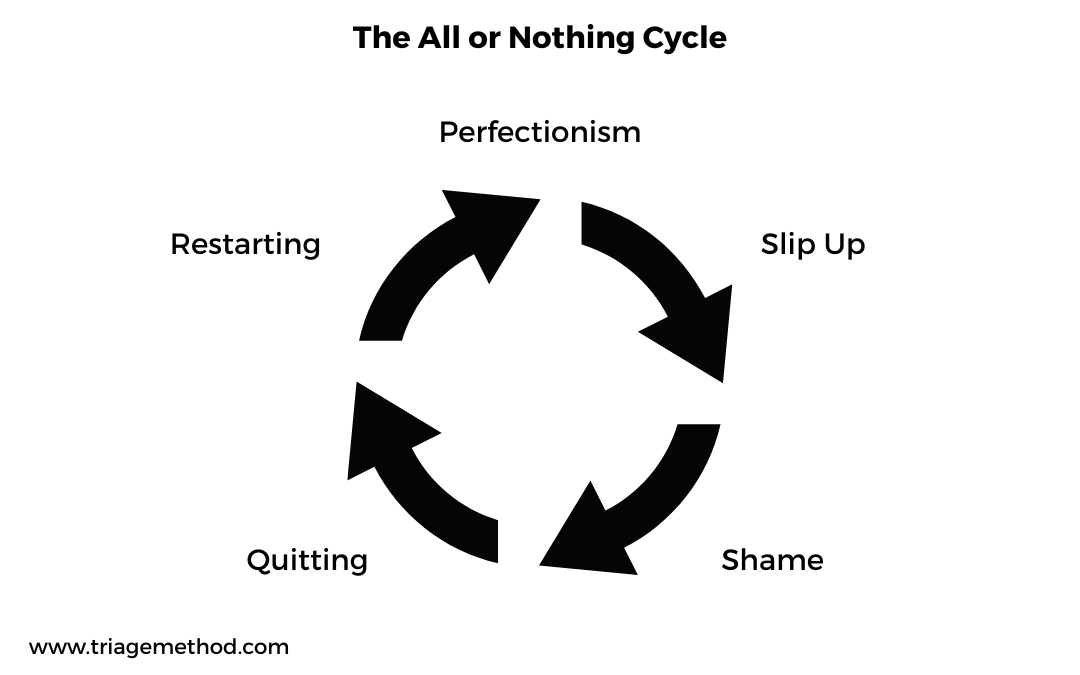
Then life happens. A stressful day at work. A dinner invitation you can’t refuse. One “off-plan” meal that somehow becomes an entire weekend. Suddenly, you’re back where you started, except now you feel worse about yourself.
I’ve coached hundreds of people through this exact cycle. And I can tell you that the harder you try to be perfect with nutrition, the more likely you are to fail. This is not because you lack discipline. It’s not because you’re weak. It’s because you’re approaching it all wrong.
Here’s a question I ask every new client who comes to me with an elaborate tracking system:
“Imagine I have a time machine. I can show you two futures. In the first, you track perfectly for six months, lose 25 pounds, look amazing in your summer photos… and then gradually regain 35 pounds over the next two years as the system collapses. In the second, you lose 20 pounds over eighteen months using a relaxed approach, and you’re still maintaining it five years later. Which future do you want?”
Every single person chooses the second future.
Then I ask: “So why is your current behaviour optimising for the first one?” This is usually met with silence.
I know why it happens. Intensity feels like progress. Rigid tracking feels like control. The dramatic transformation montage is seductive. The quiet accumulation of small wins? Boring. But the reality is that six months of perfect tracking followed by years of yo-yoing is objectively worse than decades of pretty-good eating. We know this intellectually. Yet we keep reaching for the dramatic option. This is probably because we’re wired to overvalue immediate, visible results and dramatically undervalue sustainable systems. We choose the compelling story over the winning strategy.
Now, if this isn’t clicking with you, another situation I discuss with clients goes like this:
I ask them to imagine they’re at a restaurant with old friends they haven’t seen in years. The conversation is flowing. Everyone’s ordering. There’s no nutrition information on the menu.
“What happens in your head right now?”
If the answer involves panic, elaborate mental calculations, interrogating the server, or ordering something you don’t actually want because it’s “trackable”, your system isn’t able to survive contact with real life.
If the answer is something like: “I’d probably get the salmon with vegetables, enjoy myself, and order normally tomorrow”, you’re going to be fine.
The test isn’t whether you can execute your nutrition plan in perfect conditions. A lab rat can do that. The test is whether your system functions when life happens. Most people are building lab-rat systems and wondering why they fail in the wild. This is the crux of the issue, and what I call neurotic nutrition.
The problem is that real life isn’t a controlled environment. Real life has birthdays and business dinners and stressful Tuesdays and family gatherings and vacations and nights when you’re too tired to cook. Real life has spontaneity and social connection, and foods that don’t come with nutrition labels. Real life requires flexibility, judgment, and resilience, not rigid adherence to a predetermined plan.
Your nutrition system needs to be built for the life you actually live, not the life you think you should live. It needs to work on good days and bad days. When you’re motivated and when you’re exhausted. When everything goes according to plan and when absolutely nothing does.
This is what separates approaches that last from approaches that crumble. And this is exactly why nonchalant nutrition (as counterintuitive as it might seem) is actually the more disciplined, more sophisticated, and ultimately more effective approach. It’s designed for humans living human lives, not for perfect execution in laboratory conditions.
So if you found yourself in that restaurant scenario feeling anxious rather than confident, or if you recognised yourself in that time machine question choosing intensity over sustainability, it might be time to ask yourself: are you building a system for the life you want to live, or are you building a prison you’ll eventually need to escape from?
TL;DR
The harder you grip your nutrition plan, the faster it slips through your fingers.
Most people approach nutrition like it’s a test they need to ace; tracking every calorie, weighing every portion, and treating each meal like a moral referendum. It feels disciplined. It feels serious. And it fails spectacularly within weeks.
Unfortunately, intensity is not the same as effectiveness. Six months of perfect tracking followed by complete collapse is objectively worse than years of “pretty good” eating. Yet we keep choosing the dramatic transformation over the sustainable system because intensity feels like progress.
The real question isn’t whether you can execute your nutrition plan under perfect conditions. A lab rat can do that. The question is whether your system functions when life happens; when there’s a dinner invitation, a stressful Tuesday, or a weekend that doesn’t go according to plan.
Nonchalant nutrition isn’t about caring less. It’s about building systems that survive contact with reality. Making generally solid choices without overthinking them. Allowing flexibility without guilt. Eating in patterns that support your goals and your actual life.
The paradox here is that when you stop pushing so hard, results often come faster. Because sustainable effort compounds over time in a way that white-knuckled perfection never can. Consistency beats intensity. Every single time.
You don’t need to live like a bodybuilder to lose fat and feel good. You just need to stop treating your nutrition like a prison you’ll eventually need to escape from, and start building something you can actually maintain when the initial motivation fades and real life returns.
The choice: Sprint yourself into exhaustion, or walk with purpose toward a destination you’ll actually reach.
Table of Contents
- 1 TL;DR
- 2 The Tyranny of Trying Too Hard: The Trap of Obsession and All-or-Nothing Thinking
- 3 Clean Discomfort vs. Dirty Discomfort
- 4 Why Relaxed Nutrition Works Better
- 5 What Nonchalant Nutrition Actually Looks Like
- 6 The Golden Mean: Aristotle Was Right About This Too
- 7 The Locus of Control Paradox
- 8 Anchoring Your Eating Habits in Your Values
- 9 Building Your Nonchalant Nutrition Framework
- 10 Decision Architecture: Working With Your Brain, Not Against It
- 11 Common Concerns and How to Handle Them
- 12 From Fragile to Antifragile: Why Flexibility Makes You Stronger
- 13 Real-Life Scenarios: Nonchalant vs. Neurotic Approaches
- 14 How Relaxed Nutrition Enhances the Rest of Your Life
- 15 The Stockdale Paradox: Faith and Realism
- 16 Nonchalant Nutrition: Results Come Faster When Life Comes First
- 17 Author
The Tyranny of Trying Too Hard: The Trap of Obsession and All-or-Nothing Thinking
There’s a version of nutrition advice that’s become standard in fitness culture. I call it “neurotic nutrition.” You know the type: tracking every calorie, weighing every portion, and feeling guilty about every deviation from the plan. It’s the approach that treats your body like a science experiment and your meals like equations that must balance perfectly. And look, I get the appeal. It feels serious. It feels like you’re finally taking things seriously enough to get results.
But what actually happens is you create a system so rigid and demanding that it becomes impossible to sustain. The stress of constant vigilance raises your cortisol. The mental burden of tracking everything drains your willpower. The guilt from inevitable slip-ups creates an unhealthy relationship with food. You might white-knuckle it for a week or two. Maybe even a month if you’re particularly determined. But eventually, the intensity becomes exhausting. And when you can’t maintain it anymore, you don’t just stop, you often rebound in the opposite direction.
You see, humans adapt to both positive and negative changes remarkably quickly, which is a phenomenon called hedonic adaptation. Win the lottery? You’ll be happier for a few months, then return to your baseline. Lose your job? You’ll be miserable initially, then gradually adapt. Well, the same principle applies to dietary restriction. That initial feeling of control from perfect tracking fades quickly. The system that felt empowering in week one becomes burdensome by week six. You need increasingly extreme measures to get the same psychological payoff; stricter rules, more precise tracking, greater restriction.
It’s a treadmill you can’t win on. The only way off is to build a system that doesn’t rely on the psychological high of perfectionism. I’ve watched this play out countless times. The clients who push hardest in the first few weeks are often the ones struggling most three months later. The ones who take a more relaxed approach? They’re still going strong a year later. This is why I want you to learn the art of Nonchalant Nutrition.
Let me paint you a picture. Tell nod along if any of this sounds familiar. Every meal must hit your macros within 5 grams. If you can’t track it accurately, you just won’t eat it. Restaurants become anxiety-inducing because you can’t be sure what’s in the food. Social events require advance planning and often require bringing your own meals.
One unplanned cookie on Wednesday afternoon becomes: “Well, I’ve already blown it. Might as well enjoy the rest of the week and start fresh Monday.”
Your food rules multiply like rabbits. First, it’s no sugar. Then it’s no carbs after 6 pm. Then it’s only organic vegetables. Then it’s nothing processed. Then it’s nothing with more than five ingredients. Before long, eating becomes an elaborate mental chess game. Your brain can only hold about 4-7 pieces of information in working memory at once. Every food rule you create occupies one of those slots. Neurotic nutrition overloads your cognitive capacity before you’ve even made it to lunch.
This is what I call the obsession trap, and it’s almost always paired with all-or-nothing thinking. The problem here is that rigidity creates burnout. Burnout creates inconsistency. And inconsistency is what actually prevents progress. It’s not the occasional unplanned meal or the slice of birthday cake, it’s the lack of consistency.
I see this cycle play out so often I can almost predict it now. The clients who start with the most rules? They’re the ones who end up making the least progress over time. Which I why we work so hard to break these rules in our coaching, and actually create a system that is sustainable.
Clean Discomfort vs. Dirty Discomfort
Acceptance and Commitment Therapy distinguishes between what psychologists call “clean discomfort” and “dirty discomfort.”
Clean discomfort is the inherent challenge of behaviour change. In nutrition, this is usually feeling hungry while in a calorie deficit, choosing vegetables when you’d prefer dessert, or cooking when you’d rather order takeaway. This discomfort is productive; it’s the cost of moving toward your values.
Dirty discomfort is the suffering we pile on top. The guilt, the shame, the catastrophising, the perfectionism. “I ate a cookie, therefore I’m a failure, therefore I’ll never succeed, therefore I might as well eat the whole box.”
Neurotic nutrition maximises dirty discomfort. You’re not just dealing with the inherent challenges of eating well; you’re also managing anxiety about tracking accuracy, guilt about deviations, fear of social situations, and constant mental calculations.
Nonchalant nutrition minimises dirty discomfort while accepting clean discomfort. Yes, choosing the grilled chicken over the fried chicken requires a moment of discipline. But you’re not layering on anxiety, guilt, and elaborate rules. You make the choice and move on.
This distinction is critical because dirty discomfort doesn’t make you stronger; it just makes you exhausted.
Why Relaxed Nutrition Works Better
Your body doesn’t respond to perfection. It responds to consistency. Would you rather eat pretty well 90% of the time for the rest of your life, or eat perfectly for six weeks before burning out and reverting to old habits? The choice should hopefully be obvious, but we get so caught up in the romance of discipline and the fantasy of transformation that we miss it.
Now, I do realise that it is challenging, because for 99% of human history, food scarcity was the primary nutritional challenge. Our ancestors needed to eat opportunistically when food was available. The person who passed up calories when they were abundant didn’t survive the next famine. Now, for the first time in human history, a significant portion of humanity faces the opposite problem: food abundance. This unfortunately means we’re running ancient software in a modern environment.
Neurotic nutrition tries to override these deep evolutionary drives through sheer willpower and rigid rules. It’s a daily battle against your biology. You create artificial scarcity through restriction, which activates those same ancient drives to seek and consume food when it becomes available. This is why rigid dieting so often leads to binging.
Nonchalant nutrition works with your biology instead of against it. By avoiding extreme restriction, you don’t trigger those scarcity responses. By allowing flexibility, you don’t create the psychological conditions for rebound overeating. You’re not fighting evolution, you’re designing an approach that accounts for it.
When you lower the psychological pressure around food, something interesting happens:
Fewer rebound binges. When you’re not operating from a place of restriction and deprivation, you don’t have the same urge to “make up for lost time” when you do have treats.
Easier decision-making. Without fifty rules running through your head, you can make food choices more quickly and with less stress.
Less food noise. You know that constant mental chatter about what you should or shouldn’t eat? It quiets down significantly when you’re not treating every meal like a moral referendum.
This is what I mean by nonchalant nutrition. It’s not about caring less, it’s about stressing less while still moving in the right direction. The beautiful part is that sustainability is what drives long-term progress. Not intensity. Not perfection. Just steady, consistent action over time. This is exactly what nonchalant nutrition focuses on: consistency over intensity.
The clients I’ve worked with who’ve achieved the most impressive transformations are rarely the most intense. However, they are the most consistent. And consistency comes from a system you can actually live with.
What Nonchalant Nutrition Actually Looks Like
Now, let me be clear about what I’m advocating for here, because there’s a common misconception I need to address upfront. Nonchalant nutrition is not careless nutrition. It’s not about ignoring your goals or eating whatever you want whenever you want. It’s not an excuse to bail on your commitments to yourself.
Instead, it’s about making generally solid choices without overthinking them. It’s about allowing flexibility without guilt. It’s about eating in patterns that support both your physical goals and your lifestyle priorities. You still need to respect the fundamentals; calories matter, macronutrients matter, and food quality matters. You still need to eat in a way that’s calorie-appropriate and reasonably balanced. But you don’t need the diet to be all-consuming.
I know my clients are sick and tired of hearing me say this, but all of this health and fitness stuff is meant to enhance your life, not become your life.
Most people don’t want to live like what I call a “lunchbox monk” (or a “tupperware monk” for my American readers). You don’t want to be that person who has to carry a pre-made meal to every event and situation. You don’t want to be the one who can’t participate in normal social eating without elaborate planning.
Now, if you’re trying to become a competitive bodybuilder? That level of control is often required. But let’s be honest here, most of you aren’t trying to be a bodybuilder. You’re just trying to lose a bit of fat and gain a bit of muscle. You want to look better, feel better, and have more energy.
You don’t need to live like a professional athlete to achieve that.
Imagine two archetypes here:
The Calorie Accountant tracks every transaction, balances the books daily, panics when the numbers don’t align perfectly, and treats every meal like a financial audit.
The Nutritional Navigator understands the general direction they’re heading, makes course corrections as needed, accepts that the path isn’t perfectly straight, and focuses on the long-term trajectory rather than every single decision.
Both get to the destination. But one arrives exhausted and burned out. The other arrives energised and equipped with skills that last a lifetime.
Which do you want to be?
Nonchalant nutrition is intentional, grounded, and relaxed. You have structure, but it’s flexible structure. You have standards, but they’re realistic standards. You have goals, but they coexist peacefully with the rest of your life.
Don’t let your diet become your personality. Let it be the thing that supports your personality.
The Golden Mean: Aristotle Was Right About This Too
Aristotle identified this problem 2,400 years ago. He argued that virtue lies in the mean between two extremes: courage between cowardice and recklessness, generosity between stinginess and wastefulness.
Your nutrition is no different. The deficiency is nutritional neglect: eating without any consideration for your health. The excess is what I call nutritional neurosis: obsessive tracking and rigid rules. Virtue (what Aristotle called the “golden mean”) is nonchalant nutrition: intentional without being obsessive, structured without being rigid.
What makes this insight so powerful is that Aristotle wasn’t advocating for mediocrity or “splitting the difference.” The golden mean isn’t about being lukewarm or uncommitted. It’s about finding the point of excellence that’s appropriate to the situation.
Consider courage. The coward runs from every challenge. The reckless person charges into danger without thought. The courageous person assesses the situation, understands the risks, and acts appropriately. Sometimes that means standing firm. Sometimes it means strategic retreat. The virtue is in the judgment, not in always choosing the middle option.
The same applies to your nutrition. Nonchalant nutrition doesn’t mean eating “sort of okay” or being “kind of committed.” It means being fully committed to an approach that’s sustainable. It means having enough structure to make progress, but not so much that the structure becomes the problem.
Think about it this way: if you’re trying to cross a river, the deficiency is refusing to get wet; you never make it across. The excess is diving into the deepest, fastest current; you get swept away. The virtue is finding the right crossing point, accepting you’ll get wet, and wading across at a manageable pace.
Aristotle also understood that this middle path is contextual. The right amount of food for an athlete training twice a day isn’t the same as for someone with a desk job. The right level of structure for someone who’s never tracked their eating and has no intuition around portion sizes differs dramatically from someone who’s maintained healthy habits for years and just needs gentle guardrails.
The mean is relative to you, your life, your circumstances, and your current stage of the journey.
This is profoundly practical. It means a competitive bodybuilder eight weeks out from a show and tracking every gram? That might be their golden mean for that specific context. The neurosis would be continuing that level of control when they’re in the off-season, trying to enjoy their life. The neglect would be abandoning all structure and undoing years of work.
It means a complete beginner who’s never thought about protein intake might need to track for a few weeks just to calibrate. That’s appropriate structure for building awareness. The neurosis would be continuing to track obsessively once they’ve developed the ability to eat intentionally. The neglect would be refusing to build any awareness at all.
It means someone going through a particularly stressful life period (like dealing with a family crisis, changing jobs, or moving house) might need to temporarily lower their standards and just aim for “good enough” (floor and ceiling goals are super effective here). That’s the virtue of adapting to circumstances. The neurosis would be trying to maintain peak discipline during a crisis. The neglect would be using every life challenge as an excuse to abandon all structure permanently.
This is why cookie-cutter meal plans and one-size-fits-all macro prescriptions so often fail. They ignore the fundamental principle that virtue, including nutritional virtue, is contextual and individual. They treat nutrition like a mathematical problem with one correct answer, when it’s actually a practical problem with many good answers depending on who you are and what you’re dealing with.
The coach who tells everyone to track macros strictly isn’t helping, because they’re applying the same prescription regardless of context. The influencer who tells everyone to “just eat intuitively” and abandon all structure isn’t helping either, because they’re ignoring that some people need more scaffolding than others.
The wisdom is in the assessment: What does this person need right now? What’s the deficiency they’re prone to? What’s the excess they tend toward? Where’s their golden mean?
And something that Aristotle understood that modern diet culture has forgotten is that finding your mean is a skill that develops over time. You don’t start with perfect judgment. You overshoot sometimes; too rigid, too restrictive, too many rules. You undershoot other times; too loose, too reactive, too little structure. But each time you overshoot or undershoot, you learn. You calibrate. You develop what Aristotle called phronesis (practical wisdom). The ability to judge what’s appropriate in a given situation.
This is why I tell clients that “failure” is often just calibration. You tried tracking every single thing, and it was exhausting? Good, now you know you’re past your mean. You tried eating with zero awareness, and you gained twenty pounds? Good, now you know you’re short of your mean. You’re not failing, you’re finding your range. The goal isn’t to land on your golden mean perfectly on the first try. The goal is to develop the judgment to recognise where you are in relation to it, and to make adjustments accordingly.
This is nonchalant nutrition in practice: the wisdom to know what’s appropriate for you, right now, given everything else in your life. Not too much. Not too little. Just right. And “just right” isn’t a fixed point, it moves as your life moves. That’s not instability. That’s virtue.
The Locus of Control Paradox
Now, something that surprises most people is that neurotic nutrition isn’t actually about control. Psychologists often distinguish between internal and external locus of control. People with internal locus believe they control their outcomes through their actions. External locus means believing outcomes are controlled by outside forces (luck, other people, circumstances). Well, neurotic nutrition appears to be internal locus, as you’re controlling every variable meticulously, but it’s actually external locus in disguise. Your sense of control is entirely dependent on external tools and circumstances. Without your tracking app, you’re lost. In an environment you can’t control, you spiral.
Nonchalant nutrition develops true internal locus. Your ability to make good choices isn’t dependent on having a food scale, a tracking app, or a controlled environment. It travels with you. The control is genuinely internal. It’s based on your judgment, understanding of nutritional principles, and adaptability rather than rigid rules and external validation.
This is why nonchalant eaters handle stress, travel, and unexpected situations better. Their system isn’t brittle because it isn’t dependent on external conditions being perfect.
Anchoring Your Eating Habits in Your Values
Now, before we get into the practical framework, I want you to ask yourself a few questions:
What kind of life do you actually want to lead?
How do health and fitness fit into that life? Are they meant to support it, or are they supposed to be it?
What’s the difference between discipline that uplifts you and discipline that diminishes you?
I ask these questions because I’ve seen too many people achieve their fitness goals only to realise they sacrificed things that mattered more along the way. The friendships that faded because they couldn’t be flexible about meals. The family dinners they skipped because they couldn’t hit their macros. The spontaneity and joy that disappeared under the weight of constant tracking.
Your eating behaviour should connect to meaningful values like family, career, social life, energy, confidence, and autonomy. It should complement your life, not consume it.
When I work with a new client, one of the first things I do is help them clarify what they’re actually optimising for. Because if you’re optimising purely for body composition at the expense of everything else, you might get the body you want but lose the life you wanted to live in it.
The sweet spot is where physical progress and life satisfaction overlap. That’s where nonchalant nutrition lives.
Building Your Nonchalant Nutrition Framework
Alright, let’s get practical. How do you actually do this?
First, you need to understand the basics of nutrition, especially calories and macros. I’m not going to pretend these don’t matter. They do. But the key here is that you don’t want to track them forever. Most people don’t want to log their food for the rest of their lives. That’s not a realistic or enjoyable way to live. So we need to set up systems and guardrails that allow you to eat well on autopilot.
Here’s how:
a. Simple Meal Structure
Think in terms of balanced plates, not rigid formulas.
A helpful template: protein + vegetables + an energy source (carbs, fat, or both, depending on your needs and the meal).
For most people, most meals, this is enough. You don’t need to weigh everything. You don’t need to calculate exact percentages. You just need a palm-sized portion of protein, a couple of fists of vegetables, and a reasonable amount of carbs or fats to round things out.
Is this scientifically precise? No. Does it work for the vast majority of people? Absolutely.
Of course, this is just a rough estimate, and you can actually create more specific meal structures for each of your meals, once you actually understand your nutritional needs more deeply. But this is a good starting point.
b. Flexible Consistency
This is the real magic: following helpful patterns most of the time, adjusting when needed.
Maybe your pattern is eating three solid meals a day with a protein shake after training. That’s your baseline. But on the weekend, when you have brunch with family, you adjust. You eat two larger meals instead. You skip the shake because you’re not as hungry.
The pattern gives you structure. The flexibility gives you freedom. Together, they give you sustainability.
c. “Good Enough” Choices
In any given situation, there are optimal choices, good choices, okay choices, and poor choices. Nonchalant nutrition means you’re usually aiming for “good choices”, not necessarily optimal ones.
The grilled chicken salad with dressing on the side might be optimal. The grilled chicken sandwich with a side salad is a good choice. The burger and fries is okay occasionally. The deep-fried everything platter is probably poor.
You don’t need optimal every time. You just need to be in the “good” range most of the time, with occasional “okay” choices mixed in.
d. Relaxed Awareness
Pay attention without micromanaging. This means noticing: Am I actually hungry or just bored? Is this portion size reasonable? Did I eat enough protein today? Have I had any vegetables?
It doesn’t mean tracking every calorie, weighing every portion, or calculating exact macro percentages.
It’s the difference between being conscious and being obsessive.
e. Permission to Be Human
The reality with all of this stuff is that you will slip up. This is part of the process, not a deviation from it. You’ll have days where you overeat. You’ll have weekends that get away from you. You’ll have social events where tracking isn’t realistic. You’ll have busy seasons where meal prep falls by the wayside.
None of this means you’ve failed.
The skill you’re developing isn’t perfection; it’s consistency over time. When things go off track, you simply get back on at the next available opportunity. No drama. No guilt. No waiting until Monday.
And then you learn from the slip up. Could you realistically have handled that situation better? What would you do differently if it came up again? You aren’t asking these questions from a place of self-criticism, but rather from genuine curiosity. This is how you actually improve over time. Slowly but surely you will refine your plan and create a system that actually works for you.
These are the foundations of your nonchalant nutrition framework. But we can go a little bit further to make this even more likely that you will succeed.
Decision Architecture: Working With Your Brain, Not Against It
Research on decision fatigue shows that we have a limited daily budget for willpower, or at least it feels like we do. Either way, every decision feels like it depletes this resource slightly. By evening, after hundreds of small choices, we’re running on fumes. This is why neurotic nutrition fails, as it front-loads your day with dozens of food decisions. Should I eat this? How many grams? Does it fit my macros? What if I want something else later? Can I find something trackable? Each decision drains you.
Nonchalant nutrition conserves your decision budget through what behavioural designers call “choice architecture.” You create simple default patterns like “I usually have protein and vegetables for lunch”, that require minimal willpower to execute. You reserve your limited decision-making capacity for situations that genuinely warrant it.
The meal structure I described earlier? That’s not just nutritional advice, it’s decision architecture. You’re not deciding from scratch at every meal. You’re following a template that makes good choices automatic. A thermostat doesn’t work by blasting heat constantly or shutting off completely. It maintains temperature through small, frequent adjustments around a set point. The room gets a bit cold, and the heat turns on. It gets too warm, and the heat turns off. This is called a negative feedback loop in systems thinking, and it’s how your nutrition should work.
Neurotic nutrition is like manually controlling the temperature; constantly monitoring, constantly adjusting, never able to relax. One degree off and you’re frantically making changes.
Nonchalant nutrition is like setting the thermostat. You establish a range you’re comfortable with (your general eating patterns), and you make small adjustments when you drift outside that range. You don’t panic about minor fluctuations. You trust the system to self-correct over time.
Had a heavy weekend? You naturally eat a bit lighter the next few days; not through punishment, but through restored hunger signals. Been too restrictive? Your appetite increases to compensate. The system regulates itself when you stop interfering with it.
Common Concerns and How to Handle Them
At this point, I usually hear a few predictable concerns. Let me address them.
“Won’t I lose control if I’m not tracking everything?”
This fear is understandable, especially if tracking has been your safety net. But here’s what I’ve observed: the people who track obsessively often have less control, not more. Because their system only works in controlled environments. The moment they can’t track accurately, the whole thing falls apart.
Real control comes from developing intuition and practical decision-making skills. It comes from trusting yourself to make reasonable choices without an app telling you what to do.
Start by tracking loosely for a week or two just to calibrate your portion sizes and meal patterns. Then gradually step back. You’ll be surprised how well you can maintain your habits without constant logging.
“How do I know I’m doing enough?”
This is where some basic awareness comes in handy. You should be able to answer these questions without pulling out a calculator:
- Am I eating protein at most meals?
- Am I eating vegetables regularly?
- Are my portion sizes generally reasonable?
- Am I consuming roughly the right amount of food for my goals (losing, maintaining, or gaining weight)?
If the answer to these questions is “yes,” you’re probably doing enough. Your progress over time will tell you if adjustments are needed.
“What if I stop making progress?”
Then you assess and adjust, just like you would with any approach.
The beauty of nonchalant nutrition is that it’s easier to sustain while you troubleshoot. If progress stalls, you might need to tighten things up temporarily; maybe track for a week to see where calories are actually landing, or be a bit more mindful about portion sizes.
But you’re not starting from scratch. You’re making a small adjustment to a sustainable system, not trying to white-knuckle your way through another round of extreme restriction.
From Fragile to Antifragile: Why Flexibility Makes You Stronger
You may remember from your youth the Aesop’s fable of the oak tree and the reed. The oak stood strong and rigid, proud of its ability to resist the wind. The reed bent with every breeze, appearing weak by comparison. Then came the storm. The oak, refusing to bend, was torn from the ground by the gale. The reed, flexible and adaptable, bent flat to the ground and survived.
When the storm passed, the reed stood tall again. The oak was blown over and then cut up for firewood.
Rigid nutritional rules are the oak; they feel strong, but they’re brittle. The first real storm of life snaps them. Nonchalant nutrition is the reed; flexible enough to bend without breaking, resilient enough to return to form when conditions improve.
But here’s where it gets even more interesting. The reed doesn’t just survive the storm; it gets stronger from it. Its roots dig deeper. Its flexibility is tested and proven. It learns which way to bend when the wind comes from different directions.
This is what Nassim Taleb calls antifragility: systems that don’t just withstand stress, but actually improve because of it.
There are three types of systems in the world:
Fragile systems break under stress. Think of a wine glass. Drop it, and it shatters. Neurotic nutrition is fragile. One unexpected dinner invitation, one stressful week, one holiday, and the whole system collapses. The person who’s been tracking every calorie for six weeks goes to a wedding, can’t log their food, and by Monday, they’ve abandoned the entire approach. The system had no capacity to absorb disruption.
Robust systems resist stress without breaking. Think of a plastic cup. Drop it, and it bounces. This is better than fragile, but it’s not optimal. A robust nutrition system would be one where you white-knuckle your way through challenges. You go to the wedding, you resist all temptation, you succeed through sheer willpower, but you don’t enjoy it, and you’re exhausted afterwards. The system survives, but barely.
Antifragile systems get stronger from stress. Think of your muscles; you stress them appropriately, and they grow. Nonchalant nutrition is antifragile. Every imperfect situation you navigate successfully makes you better at navigating future situations. The skills compound. The judgment improves. The confidence grows.
That dinner where you couldn’t track macros? You learned how to make reasonable choices without data. That stressful week where meal prep didn’t happen? You learned how to eat well on the fly. That holiday where you enjoyed local food? You learned that you can loosen up temporarily without losing your progress. That party where you had a few drinks and some appetisers? You learned that you can participate in normal social eating without derailing everything. Each challenge isn’t a threat; it’s training.
This is the profound difference between the two approaches. Neurotic nutrition tries to eliminate variability, control all variables, and prevent disruption. It treats every deviation as a failure. The system accumulates stress, anxiety, and a growing list of “dangerous” situations to avoid.
Nonchalant nutrition expects variability, learns from disruption, and treats deviations as data. It treats every challenge as an opportunity to build capability. The system accumulates skills, confidence, and a growing repertoire of situations you can handle.
Consider two people, both trying to lose weight:
Person A (neurotic approach) tracks obsessively for twelve weeks. They lose 18 pounds. Then they go on a week-long holiday. They can’t track their food. They panic. They either try to control everything and have a miserable time, or they give up entirely and overeat significantly. They come home feeling like they’ve failed. Within two months, they’ve regained the weight. The next time a holiday comes up, they’re even more anxious.
Person B (nonchalant approach) eats well most of the time for twelve weeks. They lose 15 pounds. Then they go on the same holiday. They eat a bit lighter at breakfast and lunch to leave room for enjoying dinners. They try local foods. They have dessert a few times. They have a great time. They come home maybe a pound or two heavier from water retention. Within a few days of normal eating, they’re back on track. The next time a holiday comes up, they’re confident because they’ve proven they can handle it.
Fast forward two years. Person A has been through three more cycles of strict dieting and regaining. They’re heavier than when they started, and they dread any disruption to their routine. Person B is thirty pounds lighter than when they started, and they’ve been on four holidays, attended countless social events, and navigated two stressful work periods, all while maintaining their progress.
This is why people who practice nonchalant nutrition often get better over time at maintaining their habits, while people who practice neurotic nutrition often get worse. One system learns and adapts with every challenge. The other just accumulates failures, anxiety, and an ever-growing list of situations that feel threatening.
Life will bring storms. Stressful work periods. Family emergencies. Holidays. Vacations. Illnesses. Celebrations. Unexpected travel. Busy seasons. The question isn’t whether these storms will come; they will. The question is whether your nutritional approach can not just survive them, but grow stronger because of them.
Do you want to be the oak or the reed? Do you want fragile or antifragile?
The oak looks more impressive. The reed looks almost careless, bending with every breeze. But when the storm inevitably comes, only one is still standing when it passes.
Real-Life Scenarios: Nonchalant vs. Neurotic Approaches
Let me show you what this looks like in practice.
Scenario 1: Dinner Out with Friends
Neurotic approach: You check the restaurant menu days in advance. You calculate calories for every possible option. You ask the server seventeen questions about preparation methods. You request all sauces on the side. You skip the appetisers and desserts while everyone else enjoys them. You spend the entire meal anxious about whether you’ve made the “right” choice. You log everything immediately and realise you’re 200 calories over your target, which ruins your evening.
Nonchalant approach: You glance at the menu when you arrive. You choose something protein-focused with vegetables, maybe the grilled fish and roasted vegetables, or the steak and salad. You skip the bread basket because you know it’ll just fill you up on empty calories, but you have a few bites of the shared appetiser because it looks delicious. You enjoy the meal and the conversation. You don’t track it. You move on with your evening. Tomorrow you eat normally.
Scenario 2: Busy Weekday
Neurotic approach: You realise at 2 pm that you forgot your meal-prepped lunch at home. Panic sets in. You can’t possibly eat out because you won’t be able to track it accurately. You either skip lunch entirely and suffer through the afternoon, or you have a protein bar and spend the rest of the day obsessing about how your macros are off.
Nonchalant approach: You realise you forgot lunch. Annoying, but not a crisis. You head to the nearest decent option, maybe a deli or a fast-casual restaurant. You order something reasonable: a grilled chicken wrap with a side salad, or a burrito bowl with protein and vegetables. It’s not what you planned, but it’s good enough. You eat it, you get back to work, you move on.
Scenario 3: Weekend Cravings
Neurotic approach: Saturday afternoon, you’re craving pizza. But pizza isn’t on your meal plan. You try to ignore it. You eat your measured chicken and broccoli. The craving doesn’t go away. By evening, you’re so fixated on what you “can’t” have that you end up eating half a pizza, a pint of ice cream, and whatever else you can find. Then you feel terrible and decide you’ve blown the whole weekend, so you might as well enjoy Sunday too before starting over Monday.
Nonchalant approach: Saturday afternoon, you’re craving pizza. You think: “Would pizza fit reasonably into my day?” If the answer is yes, you have a few slices with a side salad. You enjoy it. You don’t spiral. If the answer is no because you’ve already eaten plenty today, you acknowledge the craving, maybe plan to have pizza next weekend, and move on without drama.
Scenario 4: Social Event
Neurotic approach: There’s a party on Friday night. You spend the week dreading it because you won’t be able to control the food. You consider bringing your own meals in a lunchbox. You might even skip the event entirely because it’s too stressful to navigate. If you do go, you either eat nothing and feel miserable, or you crack under pressure and overeat significantly.
Nonchalant approach: There’s a party on Friday. You eat a bit lighter earlier in the day to leave room for party food. You show up, you eat the foods you genuinely enjoy in reasonable amounts, you skip the stuff that’s just okay. You have a drink or two if you want. You have a good time. Saturday, you eat normally. Life continues.
Which do you actually want?
The neurotic approach is sprinting through life. The nonchalant approach is walking with purpose. Both can get you where you’re going, but only one allows you to enjoy the journey and actually arrive.
I’ve laid out these scenarios because I want you to see the cumulative effect. Over weeks and months, which approach sounds more sustainable? Which one sounds like a life you’d actually want to live?
The neurotic approach might feel more “disciplined,” but it’s brittle. It breaks easily, and when it breaks, it tends to break spectacularly.
The nonchalant approach is resilient. It bends without breaking. And that resilience is what carries you through the long term.
How Relaxed Nutrition Enhances the Rest of Your Life
Here’s what I’ve seen happen when clients shift to a more nonchalant approach:
More mental space. When you’re not constantly thinking about food (calculating, tracking, worrying), you free up enormous mental bandwidth for other things. Work. Relationships. Hobbies. Actual problems that need solving.
More social enjoyment. You can say yes to invitations without anxiety. You can be present at meals instead of mentally logging everything. You can participate in normal social eating without feeling like an outsider.
Better relationship with food. Food stops being the enemy or the test. It becomes what it’s supposed to be: fuel and enjoyment in appropriate balance.
A healthier sense of control. The control you develop is real and internal, not dependent on an app or a strict set of rules. This means it travels with you, to restaurants, holidays, busy seasons, and life changes.
Fitness becoming supportive, not burdensome. This is the big one. When health and fitness enhance your life instead of dominating it, you actually want to maintain your habits. They feel like self-care, not punishment.
I’ve had clients tell me that switching to this approach improved not just their body composition, but their relationships, their career performance, and their overall sense of well-being, all because they weren’t carrying around the constant low-grade stress of dietary perfectionism.
That stress is more costly than most people realise.
The Stockdale Paradox: Faith and Realism
Admiral James Stockdale survived eight years as a POW in Vietnam. When asked who didn’t survive, he said: “The optimists. They were the ones who said, ‘We’re going to be out by Christmas.’ And Christmas would come, and Christmas would go. Then they’d say, ‘We’re going to be out by Easter.’ And Easter would come, and Easter would go. And then Thanksgiving, and then it would be Christmas again. And they died of a broken heart.”
The lesson, later termed the Stockdale Paradox by Jim Collins: “You must never confuse faith that you will prevail in the end — which you can never afford to lose — with the discipline to confront the most brutal facts of your current reality.”
Applying this to nutrition, we must maintain unwavering confidence that you’ll achieve your goals (faith in the end result) while accepting the brutal reality that it will take time, require consistency, and include imperfect days (confronting current reality).
Neurotic nutrition is all optimism, hence why you consistently say: “I’ll be perfect starting Monday!” Then Monday comes and goes. Then the next Monday. Eventually, your faith breaks.
Nonchalant nutrition is the Stockdale Paradox in action: absolute confidence in your eventual success combined with acceptance that the path includes imperfection, adaptation, and patience.
You will get there. But it won’t be perfect. And that’s not just okay, it’s necessary.
Nonchalant Nutrition: Results Come Faster When Life Comes First
Here’s the paradox: when you stop pushing so hard, you often get better results. Because sustainable effort compounds over time in a way that intense, unsustainable effort never can.
Behavioural economics has identified a consistent pattern in human decision-making: we dramatically overvalue immediate rewards and undervalue future ones. A hundred euros today feels more valuable than a hundred and ten euros next month, even though waiting is objectively better. This is called hyperbolic discounting, and it’s why neurotic nutrition feels so appealing initially. The immediate psychological reward of feeling disciplined, in control, and committed is vivid and present. The long-term cost of burnout, damaged relationship with food, and inconsistency is abstract and distant.
Your brain is essentially saying: “Tracking every calorie TODAY feels like progress” while discounting “being miserable and inconsistent in THREE MONTHS.”
Nonchalant nutrition inverts this. It sacrifices the immediate psychological reward of perfect tracking for the long-term reward of sustainable progress. It feels less impressive in week one. But in month six? Year two? It’s not even close.
Think about someone who diets hard for six weeks, loses 10 pounds, burns out, and regains 15 pounds over the next three months. Then repeat that cycle twice a year for five years. Where are they? Probably worse off than when they started.
Now think about someone who makes gradual, sustainable changes. They eat pretty well most of the time. They’re consistent with their training. They handle social situations and busy periods without drama. They lose weight slowly—maybe 30 pounds over two years. Where are they? In a completely different place. With habits that will last.
I know which outcome I’d choose.
Nutrition shouldn’t dominate your life. It should enhance it. It should give you energy, confidence, and freedom, not stress, guilt, and restriction. The nonchalant nutrition path is calm, consistent, and aligned with what genuinely matters to you. It respects both your goals and your humanity. And progress is easier when you stop pushing so hard. When you give yourself permission to be human. When you build systems that work with your life instead of against it.
So take a breath. Relax your grip. Trust the process. You don’t need to be perfect. You just need to be consistent. And consistency comes easiest when you’re not making yourself miserable in pursuit of it. That’s nonchalant nutrition. And it works.
If you need more help with your own nutrition, you can always reach out to us and get online coaching, or alternatively, you can interact with our free content, especially our free nutrition content.
If you want more free information on nutrition or training, you can follow us on Instagram, YouTube or listen to the podcast, where we discuss all the little intricacies of exercise and nutrition. You can always stay up to date with our latest content by subscribing to our newsletter.
Finally, if you want to learn how to coach nutrition, then consider our Nutrition Coach Certification course, and if you want to learn to get better at exercise program design, then consider our course on exercise program design. We do have other courses available too. If you don’t understand something, or you just need clarification, you can always reach out to us on Instagram or via email.
References and Further Reading
Smith CF, Williamson DA, Bray GA, Ryan DH. Flexible vs. Rigid dieting strategies: relationship with adverse behavioral outcomes. Appetite. 1999;32(3):295-305. doi:10.1006/appe.1998.0204 https://pubmed.ncbi.nlm.nih.gov/10336790/
Westenhoefer J, Stunkard AJ, Pudel V. Validation of the flexible and rigid control dimensions of dietary restraint. Int J Eat Disord. 1999;26(1):53-64. doi:10.1002/(sici)1098-108x(199907)26:1<53::aid-eat7>3.0.co;2-n https://pubmed.ncbi.nlm.nih.gov/10349584/
Berg AC, Johnson KB, Straight CR, et al. Flexible Eating Behavior Predicts Greater Weight Loss Following a Diet and Exercise Intervention in Older Women. J Nutr Gerontol Geriatr. 2018;37(1):14-29. doi:10.1080/21551197.2018.1435433 https://pubmed.ncbi.nlm.nih.gov/29494790/
Sairanen E, Lappalainen R, Lapveteläinen A, Tolvanen A, Karhunen L. Flexibility in weight management. Eat Behav. 2014;15(2):218-224. doi:10.1016/j.eatbeh.2014.01.008 https://pubmed.ncbi.nlm.nih.gov/24854807/
Westenhoefer J, Engel D, Holst C, et al. Cognitive and weight-related correlates of flexible and rigid restrained eating behaviour. Eat Behav. 2013;14(1):69-72. doi:10.1016/j.eatbeh.2012.10.015 https://pubmed.ncbi.nlm.nih.gov/23265405/
Linardon J, Mitchell S. Rigid dietary control, flexible dietary control, and intuitive eating: Evidence for their differential relationship to disordered eating and body image concerns. Eat Behav. 2017;26:16-22. doi:10.1016/j.eatbeh.2017.01.008 https://pubmed.ncbi.nlm.nih.gov/28131005/
Wing RR, Phelan S. Long-term weight loss maintenance. Am J Clin Nutr. 2005;82(1 Suppl):222S-225S. doi:10.1093/ajcn/82.1.222S https://pubmed.ncbi.nlm.nih.gov/16002825/
Anderson JW, Konz EC, Frederich RC, Wood CL. Long-term weight-loss maintenance: a meta-analysis of US studies. Am J Clin Nutr. 2001;74(5):579-584. doi:10.1093/ajcn/74.5.579 https://pubmed.ncbi.nlm.nih.gov/11684524/
Kim JY. Optimal Diet Strategies for Weight Loss and Weight Loss Maintenance. J Obes Metab Syndr. 2021;30(1):20-31. doi:10.7570/jomes20065 https://pubmed.ncbi.nlm.nih.gov/33107442/
Meule A, Westenhöfer J, Kübler A. Food cravings mediate the relationship between rigid, but not flexible control of eating behavior and dieting success. Appetite. 2011;57(3):582-584. doi:10.1016/j.appet.2011.07.013 https://pubmed.ncbi.nlm.nih.gov/21824503/
Conlin LA, Aguilar DT, Rogers GE, Campbell BI. Flexible vs. rigid dieting in resistance-trained individuals seeking to optimize their physiques: A randomized controlled trial. J Int Soc Sports Nutr. 2021;18(1):52. Published 2021 Jun 29. doi:10.1186/s12970-021-00452-2 https://pubmed.ncbi.nlm.nih.gov/34187492/
Bairey Merz CN, Olson MB, Kelsey SF, et al. Weight cycling and cardiovascular outcome in women with suspected ischemia: A report from the NHLBI-sponsored WISE Study. PLoS One. 2018;13(12):e0207223. Published 2018 Dec 3. doi:10.1371/journal.pone.0207223 https://pubmed.ncbi.nlm.nih.gov/30507935/
Green MW, Rogers PJ, Elliman NA, Gatenby SJ. Impairment of cognitive performance associated with dieting and high levels of dietary restraint. Physiol Behav. 1994;55(3):447-452. doi:10.1016/0031-9384(94)90099-x https://pubmed.ncbi.nlm.nih.gov/8190760/
Tylka TL, Calogero RM, Daníelsdóttir S. Is intuitive eating the same as flexible dietary control? Their links to each other and well-being could provide an answer. Appetite. 2015;95:166-175. doi:10.1016/j.appet.2015.07.004 https://pubmed.ncbi.nlm.nih.gov/26162949/
Sairanen E, Tolvanen A, Karhunen L, et al. Psychological flexibility mediates change in intuitive eating regulation in acceptance and commitment therapy interventions. Public Health Nutr. 2017;20(9):1681-1691. doi:10.1017/S1368980017000441 https://pubmed.ncbi.nlm.nih.gov/28414018/
Tylka TL, Calogero RM, Daníelsdóttir S. Intuitive eating is connected to self-reported weight stability in community women and men. Eat Disord. 2020;28(3):256-264. doi:10.1080/10640266.2019.1580126 https://pubmed.ncbi.nlm.nih.gov/30821648/
Pignatiello GA, Martin RJ, Hickman RL Jr. Decision fatigue: A conceptual analysis. J Health Psychol. 2020;25(1):123-135. doi:10.1177/1359105318763510 https://pubmed.ncbi.nlm.nih.gov/29569950/
